What should an HR tech or hiring website include?
An HR tech or hiring website should give employers and candidates their own clear path, show how the product works with real screens, and back every claim with proof. Job or talent pages should live on your own domain so they build search traffic for you.
The home page sets the split. A short line for each audience, two clear buttons, then sections that serve each side without mixing the message.
What employers and candidates look for
Employers want to know how fast they can hire, the quality of candidates, what it costs and how it fits their current tools.
Candidates want to know the roles are real, the process is fair, and their data is safe. Clear steps, response times and a privacy summary go a long way.
We design separate sections, and often separate pages, so each group gets straight answers.
Must-have pages for a hiring site
- Home with a split path for employers and candidates
- For employers: product, how it works, pricing, demo
- For candidates: how it works, open roles or talent sign up
- Jobs or talent directory, driven by the CMS
- Case studies from hiring teams
- Integrations with ATS and HR tools
- Trust: fairness, data and privacy
- Blog and hiring guides
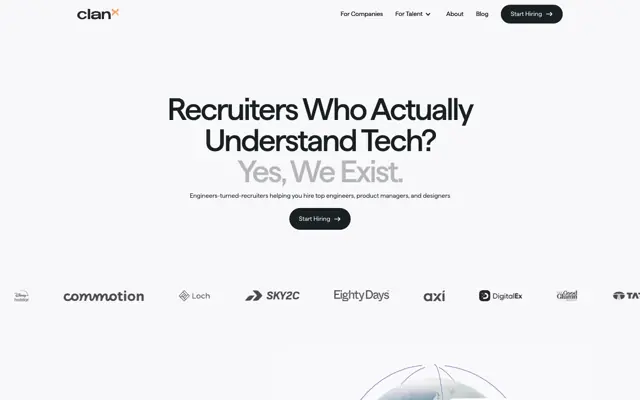
For ClanX we built a two-sided Webflow site with CMS-driven talent pages, custom code and SEO from day one. You can see it in the work slider above.
Fairness, data and trust signals
Hiring touches people's livelihoods, so trust is central. Explain how screening works, where humans are involved, and how candidates can ask questions or request their data.
If you use AI in hiring, say so clearly and describe what it does. Rules on automated hiring decisions are growing in several places, so your legal team should review this copy. We give it a clear, visible home on the site.
Only collect what you need in application forms, and link to your privacy policy right next to the submit button.
SEO and AEO for HR and hiring
Job pages are some of the best SEO assets a hiring business has. One page per role with a clear title, location and JobPosting schema can appear in job search features and bring candidates straight to you.
On the employer side, guide pages on hiring for specific roles, interview questions and salary ranges attract buyers. Answer-first openings and FAQ schema help those pages show in AI answers too. See our SEO, AEO and GEO service.
Webflow or Astro for a hiring platform?
Webflow fits most HR tech marketing sites. The CMS handles jobs, talent profiles and case studies, and tools like Zapier or Airtable can keep it in sync with your systems.
Astro fits when you have thousands of job or profile pages coming from an API, or want full control in code. It builds static pages fast and keeps them light. Compare on Webflow vs Astro, or read about Webflow integrations.
Hiring website launch checklist
- Separate, clear paths for employers and candidates on the home page
- Every job or talent page with a clean URL, title and schema
- Application and demo forms tested and routed to your ATS or CRM
- Expired roles handled so they do not leave dead pages
- Fairness, data and privacy section live and reviewed
- Employer case studies with real names, used with permission
- Sitemap updated automatically as roles change
- Team trained to add roles and profiles