- Pick a freelance Webflow developer for small, well defined jobs with a finished design and a flexible deadline.
- Pick a Webflow agency when you need design, build, SEO and support together, or when a missed deadline would hurt.
- Freelancers usually cost less per hour. Agencies cost more but add cover, process and a wider skill set.
- The biggest risk with a solo freelancer is availability. The biggest risk with an agency is being handed to a junior.
- Whoever you pick, check live work, ask about class naming and CMS, and make sure the site lives in your workspace.
The short answer
Choose a freelance Webflow developer if the job is small, the design is finished and you can live with some flexibility on dates. Choose a Webflow agency if you need several skills at once, a firm launch date, or ongoing help you can count on every week.
Both can build great Webflow sites. Plenty of excellent freelancers outwork agencies, and plenty of agencies are just one person with a big logo. What matters is matching the shape of your project to the shape of the team.
A useful way to think about it: a freelancer sells you their time and skill. An agency sells you a result and the process that gets you there. If you already know exactly what you need and can manage the project yourself, buying time is often enough. If you want someone else to own the outcome, you are buying a process.
We are an agency, so take our view with that in mind. We have tried to keep this fair, and we tell people to hire a freelancer when that is the better fit.
Side by side
| Feature | Freelance Webflow developer | Webflow agency |
|---|---|---|
| Price per hour | Usually lower | Usually higher |
| Skills | One person, often build only | Design, build, SEO, copy and support |
| Speed | Fast for small jobs | Faster for big jobs, work runs in parallel |
| Holidays and sick days | Work pauses | Someone else picks it up |
| Process | Varies a lot | Usually a set process and checklists |
| Direct contact | You talk to the builder | You may talk to a project manager |
| Long term support | Depends on their workload | Retainers and care plans |
We go deeper on this in Kookies vs a freelancer.
When a freelance Webflow developer is the right call
- You have a finished Figma file and need it built, nothing more.
- The job is small: a landing page, a new section or a handful of fixes.
- Your budget is tight and the deadline is flexible.
- You already have a designer, a writer and an SEO person, and you only need the build piece.
- You want to work with one person directly and like a close, informal way of working.
A strong freelancer with a clear scope can be the best value option there is. Just plan for what happens if they are booked up or away when you need a change.
Freelancers are also great for teams that already have a Webflow site in good shape. If the class system and CMS are clean, a freelancer can add pages and sections quickly without needing to rethink anything.
When a Webflow agency makes more sense
- You need design and build together. Handoffs between separate freelancers are where most projects slip.
- You have a launch date that cannot move, like a funding announcement or a product launch.
- You are migrating from WordPress or Wix and need redirects, content transfer and SEO checks done properly.
- Your site will grow every month and you want one team that knows it inside out.
- You need integrations with your CRM, analytics or product.
An agency also tends to have a repeatable process. That means fewer surprises, because the same checks happen on every project.
It also tends to bring opinions. A good agency will push back on a weak page structure, a confusing navigation or a form with too many fields. That pushback is part of what you pay for. If you only want someone to build exactly what you hand over, a freelancer may be a better match.
What it really costs
Freelancers usually charge less per hour. That does not always mean the project costs less overall. An agency can run design and build at the same time, so the total hours on the calendar can be shorter.
Compare total project cost, not hourly rate. Then add the cost of delay. If a late launch means a missed campaign, the cheaper option may not be cheaper.
Also count your own time. With a freelancer, you often coordinate the designer, the writer and the developer yourself. With an agency, someone else does that. If your hour is worth a lot, that coordination is a real cost, even if it never shows up on an invoice.
For reference, our prices are $35 an hour, $500 for a landing page, from $2,500 for a site up to 5 pages and from $3,000 for larger sites. That sits close to many freelance rates, which is one reason clients come to us. See the full breakdown in how much a Webflow developer costs.
The risks on each side
Freelancer risks
- One person is a single point of failure. Illness, a bigger client or a holiday stops your project.
- Skills outside the build, like SEO or copy, may be thin.
- Some freelancers keep the site in their own account. Always check.
Agency risks
- The senior person sells the project, then a junior builds it.
- Extra layers of project management can slow simple changes.
- Bigger overheads can mean higher prices for the same output.
Ask both types the same question: "Who exactly will build my site, and who covers them if they are away?" The answer tells you most of what you need.
Whichever you choose, protect yourself the same way. Keep the site in your own Webflow workspace. Get a written scope. Ask for a style guide page and a walkthrough video at handover. Those three things make it easy to switch later if the fit is wrong.
A middle path many teams take
You do not have to pick one forever. A common setup is to use an agency for the main build, then switch to a freelancer or the Webflow Editor for small updates. Another is to hire a freelancer for a landing page now, and bring in an agency later for the full site.
What makes this work is a clean build. If the class system and CMS are tidy, anyone can pick the site up later. That is why we leave every client with a style guide page, components and a recorded walkthrough.
Another option is a monthly plan with an agency instead of a project. You get a team on call for new pages, fixes and campaigns, without hiring in house. Our Webflow care plan works this way: unlimited requests, handled one at a time, at $4,000 a month month to month or $3,000 a month on a 6 month term.
What working with each feels like
Price and skills matter, but the day to day feel matters too. You will spend weeks talking to these people.
With a freelancer
You usually message the person doing the work. Questions get quick, direct answers. Small changes can happen the same day. The flip side is that one person is juggling several clients, so there will be days when they are heads down on someone else's launch and your message waits.
With an agency
You usually get a shared channel, a project lead and set check ins. Work moves in planned steps: design review, build, staging review, launch. It can feel more formal. It also means nothing depends on one inbox, and the project keeps moving when someone takes a week off.
Neither is better in general. Some founders love the directness of one person. Some marketing teams need the structure. Think about how your own team likes to work.
How to vet a Webflow agency
- Ask who builds your site. Get names. Ask to meet the developer, not just the founder or sales lead.
- Check their partner status. Webflow lists its partners in a public directory, so you can see their profile and work.
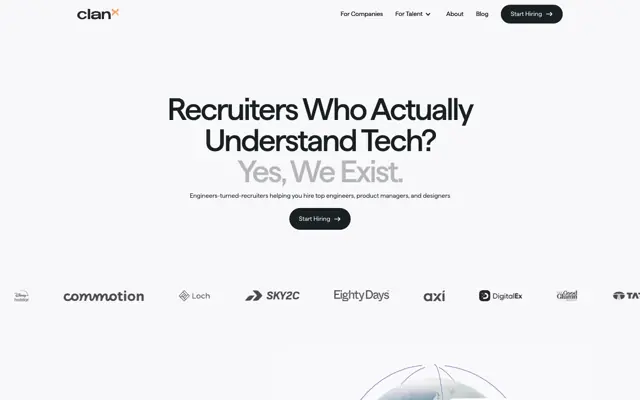
- Look at case studies with results. Not just screenshots. What changed for the client after launch? Our ClanX case study is an example of what to look for.
- Ask about their process. A good agency can show you the steps, the checklists and what you need to do at each stage.
- Read the scope carefully. Agencies sometimes quote a low base and add a lot of extras. Make sure SEO, CMS setup and support are in the number.
How to vet a freelance Webflow developer
- Open three live sites on your phone and run a speed test on each.
- Ask for a read-only Designer link to see how they name classes and build components.
- Ask about their current workload. How many projects are they running at once? When can they actually start?
- Ask what happens if they are ill. Some freelancers have a trusted partner who can step in. That is a great sign.
- Agree on response times. Same day, next day, or end of week. Write it down.
- Start with a small paid task. One section or one landing page shows you more than any call.
A freelancer who passes all of these is often a great hire. Many of the best Webflow developers we know work alone.
Questions to ask either option
- Can I see three live Webflow sites you built, and a read-only link to one?
- How do you name classes and structure components?
- How do you plan the CMS?
- What do you check before launch?
- Will the site be in my Webflow workspace?
- What does support look like after launch, and what does it cost?
Our guide on how to hire a Webflow developer covers each of these in more detail, including red flags.
A simple way to decide
Answer three questions:
- Do you need more than one skill (design, build, SEO, copy)?
- Would a two week delay cost you real money?
- Will the site need regular changes after launch?
Two or more yes answers point to an agency. Mostly no points to a freelancer. If you are still unsure, book a short call with each and see who asks better questions about your business. That is usually the one to hire.
If you want to talk it through with us, book a 20 minute call. We will tell you honestly if a freelancer is a better fit. You can also look at our Webflow development page to see what is included.

Terms used: Webflow, Core Web Vitals