
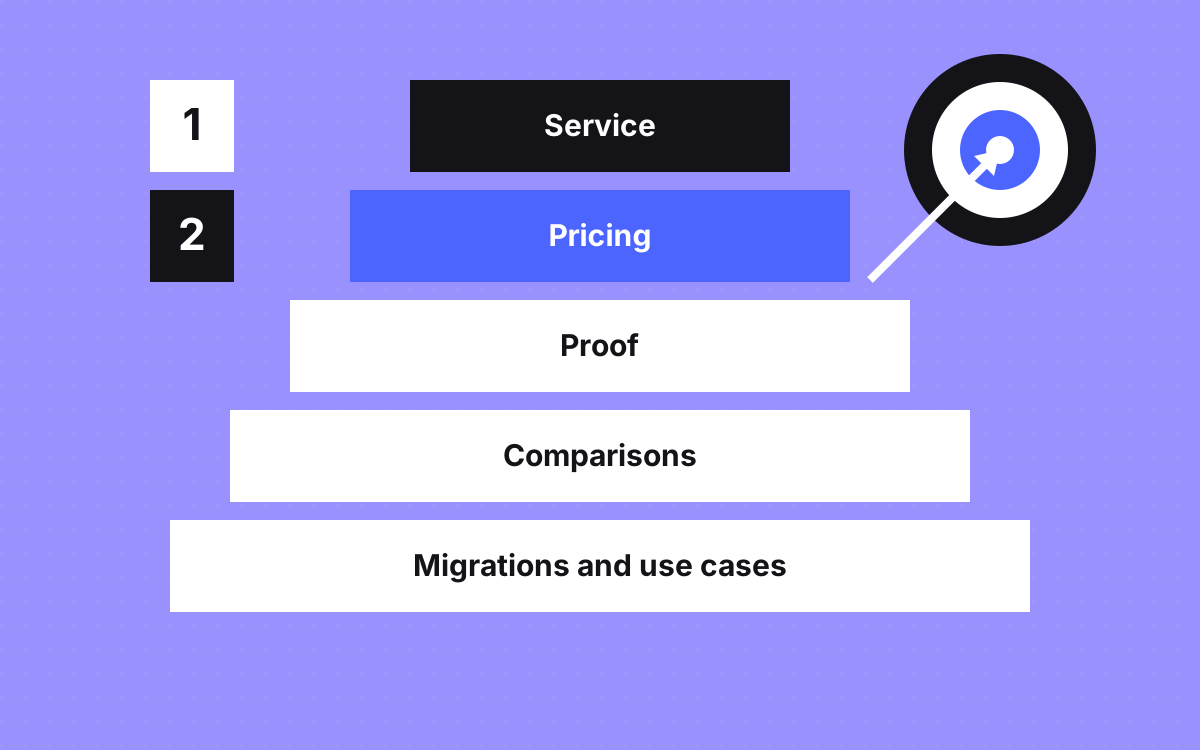
- High-intent pages serve people who are already choosing: service, pricing, proof, comparison, migration, use case and integration pages.
- Build them before broad blog posts. Volume matters less here, since one good lead can be worth more than many casual visits.
- Score each idea on four questions: do buyers ask it, can you say something true and specific, can the page convert, and how hard is it to make.
- Every page needs an answer, a price or a way to get one, real proof and one clear next step.
- Template pages are fine if each one is really different. Near-copies risk being treated as doorway pages.
The short answer
Build pages for people who are already choosing, in this order: a service page for each main offer, pricing, proof, comparisons, migration pages, use case pages, integration pages, and only then location pages. Do these before broad blog posts. These pages get less traffic, and they reach people close to a decision.
The right order for your site depends on what you sell. The scoring rule below will show you. For the full set of pages on a software site, read the pages every SaaS website needs.
How to spot high intent
The words in a search say how close someone is to choosing. See search intent for the wider idea.
| What they type | What they want | Page to build |
|---|---|---|
| [service] agency, hire [role] | Someone to do the work | Service page |
| [product] pricing, [service] cost | A number, or a way to get one | Pricing page |
| [you] vs [rival] | A fair call between two options | Comparison page |
| [rival] alternatives | A reason to leave | Alternatives page |
| move from [old] to [new] | A safe path, and who can do it | Migration page |
| [product] for [industry or role] | Proof it fits their case | Use case page |
| [product] with [tool] | Confirmation it connects | Integration page |
| [service] in [country] | A local option, or overlap in hours | Location page |
The build order, and why
- Service page per main offer. Every sales link and most ads need somewhere to land. See landing pages.
- Pricing. People look for it early. If you quote per project, say what changes the price and give a starting point if you can. Ours is at pricing.
- Proof. Case studies with what you actually did. Comparison and service pages need them, so they come early. See our work for the format.
- Comparisons. Buyers are already comparing, with or without you. We run this on our own site: see the compare hub.
- Migration pages. If you replace something, this is a person with a dated problem.
- Use case and industry pages. Build these where your proof and offer are really different.
- Integration pages. Worth it when buyers ask whether you connect to a tool. Ours sit under integrations.
- Location pages. Only with real local detail. If you cannot say anything specific about a place, skip it.
A rule for scoring ideas
Score each idea from 1 to 3 on four questions, and add them up. Build the highest first. Scores are your judgement, so have sales check them.
- Do buyers ask this? 3 if it comes up on calls or in lost deals. 1 if it is only your guess.
- Can you say something true and specific? 3 if you have proof and real detail. 1 if you would be repeating what is already out there.
- Can the page turn into a lead? 3 if the next step is obvious. 1 if the reader is far from buying.
- How easy is it to make? 3 if you have the material now. 1 if it needs work from other teams.
A made-up example, for a B2B analytics product. These are judgement calls for illustration, not data:
| Page idea | Asked | Specific | Lead | Easy | Total |
|---|---|---|---|---|---|
| Us vs the rival we meet most | 3 | 3 | 3 | 2 | 11 |
| Move from spreadsheets | 3 | 2 | 3 | 3 | 11 |
| Integration with a tool few customers use | 1 | 2 | 2 | 3 | 8 |
| What is data analytics? | 1 | 1 | 1 | 3 | 6 |
Search volume is missing from the score on purpose. Check it afterwards as a tie-breaker. A query with few searches can still bring your best lead, and keyword tools can miss very specific phrases.
What every one of these pages needs
- The answer first. Say what you do and for whom in the first lines. See answer-first content.
- A price, or a way to get one. Hiding it sends people to look elsewhere.
- Proof that matches. A case or quote from the same kind of buyer, only if it is real.
- What happens next. Steps, time and who they will talk to.
- FAQ from real calls. The objections you hear, answered plainly.
- One clear action. One main button, and a short form that works on a phone. See how we design landing pages.
Comparison pages that get trusted
A buyer knows you wrote the page. Being fair is what makes it useful.
- Say plainly who should pick the other option, and when.
- Check each claim about a rival against its own docs, and review it on a schedule, since products change.
- Leave out rival prices you cannot keep current. Link to their pricing page instead.
- Compare on what buyers decide on, and leave out rows you included only because you win them.
For an example, read Webflow vs Framer.
Many pages from one template
Some high-intent pages come in sets: one per role, tool or industry. A CMS template fits. Scaler wanted a landing page for each role they teach, so we built one template the team fills from the CMS. ClanX creates role landing pages by sending data to the Webflow CMS API, with no Designer work per page.
The risk is near-copies. Google's spam policies describe doorway abuse as pages made to rank for similar queries, and list near-identical pages and city pages that all funnel to one page among the examples. A useful test: if you removed the swapped-in name, would the page still say something different from its siblings? Our post on CMS API landing pages shows where the line sits.
Where to find the first ideas
- Sales calls. Ask for the last ten questions and the rivals named.
- Lost deals. Why did they go elsewhere? Those objections are page topics.
- Your own Search Console. Filter queries for words such as pricing, vs and alternative.
- Support and onboarding. What did customers use before you? That gives you migration pages.
- AI tools. Try the questions buyers would ask, and see which options get named. Answers vary, so treat it as a prompt for ideas. See how to get cited.
How to measure these pages
Do not judge them on traffic, since they may never get much. Watch:
- Leads by page and by page type. Which set brings enquiries? See tracking setup.
- Lead quality. Ask sales which pages their good leads came through.
- Use in sales. Are reps sending the page to prospects? That counts too.
- A form field. "How did you hear about us?" often tells you what analytics cannot.
What can wait
Broad "what is" articles, glossary pages and opinion posts have their place. They build reach and give people something to link to. But they come after buyers can find a clear page for each thing you sell. If your blog has dozens of posts and your main service page is thin, fix the service page first.
What to do next
Write down your ten best page ideas, ask sales to score them with you, and build the top three. Check each against the list above before it goes live. If you want them built, see landing pages or SEO and AEO, or tell us what you sell. We will tell you which we would build first. We cannot promise rankings or leads, but we can give you pages that are clear and true.

Terms used: Core Web Vitals, AEO