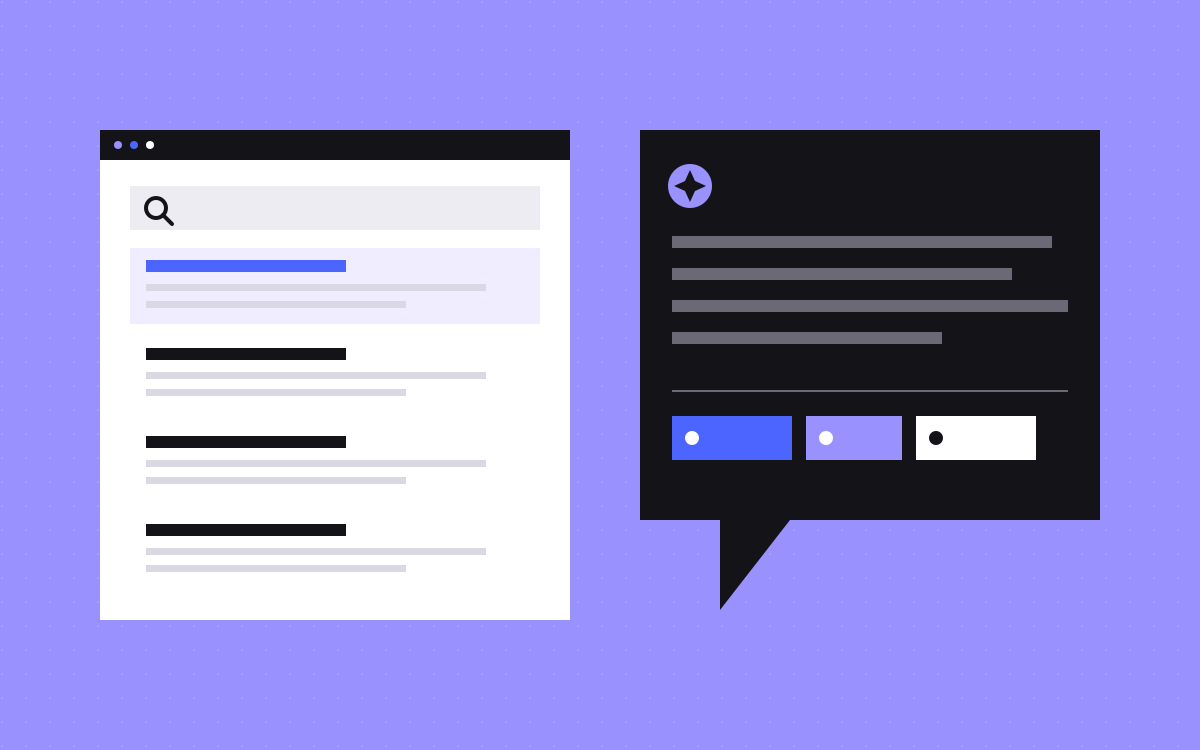
- SEO aims to earn a place in search results. GEO aims to get your brand mentioned and cited in answers from AI tools.
- Most of the work overlaps: crawlable pages, clear content, real expertise and links from others.
- GEO adds a focus on direct answers, facts that are easy to quote, and being mentioned on other trusted sites.
- Google says AI Overviews and AI Mode need no special files or markup beyond normal SEO good practice.
- Nobody can promise a citation in an AI answer. Do the foundations first, then measure and test.
The short answer
SEO is the work of earning a place in search results. GEO, generative engine optimisation, is the work of getting your brand mentioned and cited in answers from AI tools such as ChatGPT, Claude, Perplexity and Gemini. They are not rivals. Good GEO stands on good SEO, and most of the work helps both.
If you have to choose where to begin, begin with SEO. A page that cannot be crawled, or that says nothing clear, will not do well in either.
What SEO is about
A search engine gives people a list of results and they choose where to click. SEO helps your page earn a good place on that list. The main parts are:
- Technical health. Pages can be crawled and indexed, with a clean sitemap, correct canonical URLs and working redirects.
- Content that matches intent. Pages answer what the searcher wants. See search intent.
- Authority. Other sites link to you, and your own internal links are sensible.
- Page experience. The site is fast and works on phones.
Success shows up as impressions, rankings, clicks and leads.
What GEO is about
An AI tool writes one answer, often with a few sources. There is no list of ten results to climb. You want to be one of the sources it draws on, or a brand it names. So GEO focuses on:
- Direct answers. Say the answer early in a section, in a sentence that still makes sense when lifted out of the page.
- Facts that are easy to check. Specific details, clear definitions, dates and named authors.
- Being talked about elsewhere. Reviews, directories, articles and community posts that mention you. AI tools do not only read your own site.
- Access. Crawlers for AI tools can reach your pages, if you choose to allow them.
Success is harder to count. It shows up as mentions, citations, some referral traffic, and people saying they found you through an AI tool.
Where GEO and AEO fit
You will also see AEO, answer engine optimisation. People use these words in overlapping ways. On this site, AEO means shaping pages so they can be quoted as answers, and GEO means being mentioned and cited across AI tools. The names matter less than the work. For more detail, read What is AEO? and how to get cited by ChatGPT and Perplexity.
What actually overlaps
- Crawlable pages. Neither can use what it cannot reach. Keep important content in the HTML as text.
- Clear structure. Good headings and short sections help readers, search engines and AI tools.
- Real expertise. First-hand detail, named authors and honest limits. See E-E-A-T.
- Links and mentions. Being cited by others helps in both worlds.
- Fresh, correct facts. Out of date pricing or features hurt trust everywhere.
This overlap is why we treat them as one job on our SEO and AEO work, with a few extra steps for AI.
What Google says about AI features
Google's guidance for AI features is clear and worth reading. For AI Overviews and AI Mode, a page needs to be indexed and eligible to show with a snippet in Search. Google says there are no further technical requirements, and that normal SEO good practice still applies. It also says you do not need new machine-readable files, AI text files or special schema just for these features.
That is Google only. Other AI tools work in their own ways and share less about it. So an optional file such as llms.txt is a small extra at most, not a strategy. Our llms.txt guide covers what it can and cannot do.
Where they really differ
- The result. SEO gives you a link in a list. GEO may give you a sentence, a mention or a small citation.
- The click. With SEO the click is the goal. With AI answers, people may get what they need with no click at all, so being named has value of its own. See zero click search.
- The query. People type short searches, but they ask AI tools longer questions with more context. Pages that handle specific situations and comparisons have more to offer.
- Off-site weight. SEO has always cared about links. GEO also cares about plain mentions, in places where people discuss your category.
- Stability. Rankings move, but you can track them. AI answers can change from one try to the next, so a single test proves little.
What to do first
- Fix the basics. Use Search Console to find pages that are not indexed or that have errors.
- Check your robots.txt and any firewall rules. Decide on purpose which crawlers you allow, including AI crawlers such as GPTBot, ClaudeBot and PerplexityBot. Each vendor documents its own.
- Rewrite your key pages so each section opens with a direct answer.
- Add honest comparison and how-it-works pages, since people ask AI tools to compare options.
- Add schema markup that matches what is on the page. It helps machines read the page, but it is not a shortcut to citations.
- Get listed and reviewed in places your buyers trust, with the same company facts everywhere.
If you are on Webflow, our Webflow SEO checklist covers much of this.
How to measure GEO without fooling yourself
- Search Console. Google says traffic from its AI features is counted in the Performance report under the Web search type. Treat it as part of the overall trend.
- Referrals. In GA4, look for visits from sites such as chatgpt.com and perplexity.ai. Many visits may not pass a referrer, so treat this as a floor.
- Prompt checks. Keep a list of real buyer questions and try them in each tool once a month. Note who gets named. Answers vary, so look for patterns.
- Ask people. Add a "How did you hear about us?" field to your form. It is simple and often the most useful signal.
What to watch out for
- Promises of placement. No one controls what an AI tool says. Be careful with anyone who guarantees citations.
- Stuffing. Filling pages with keywords, or repeating your brand name in odd sentences, makes the page worse for people.
- Thin AI content at scale. Publishing hundreds of generic pages adds little and can harm trust.
- Dropping SEO. Search is still where many buyers start, and AI answers often draw on the open web.
What to do next
Treat GEO as an extra layer on sound SEO, not a separate project. Start with one important page, make it clear and quotable, and build from there. If you want help, see SEO and AEO or Webflow SEO, or send us your site. We can tell you what we would fix first, but we cannot promise rankings or citations, and nobody honestly can.
More reading: what actually moves rankings on Webflow and our schema markup guide.

Terms used: AI Overviews, Core Web Vitals